
Resume With No Experience: A Practical Guide
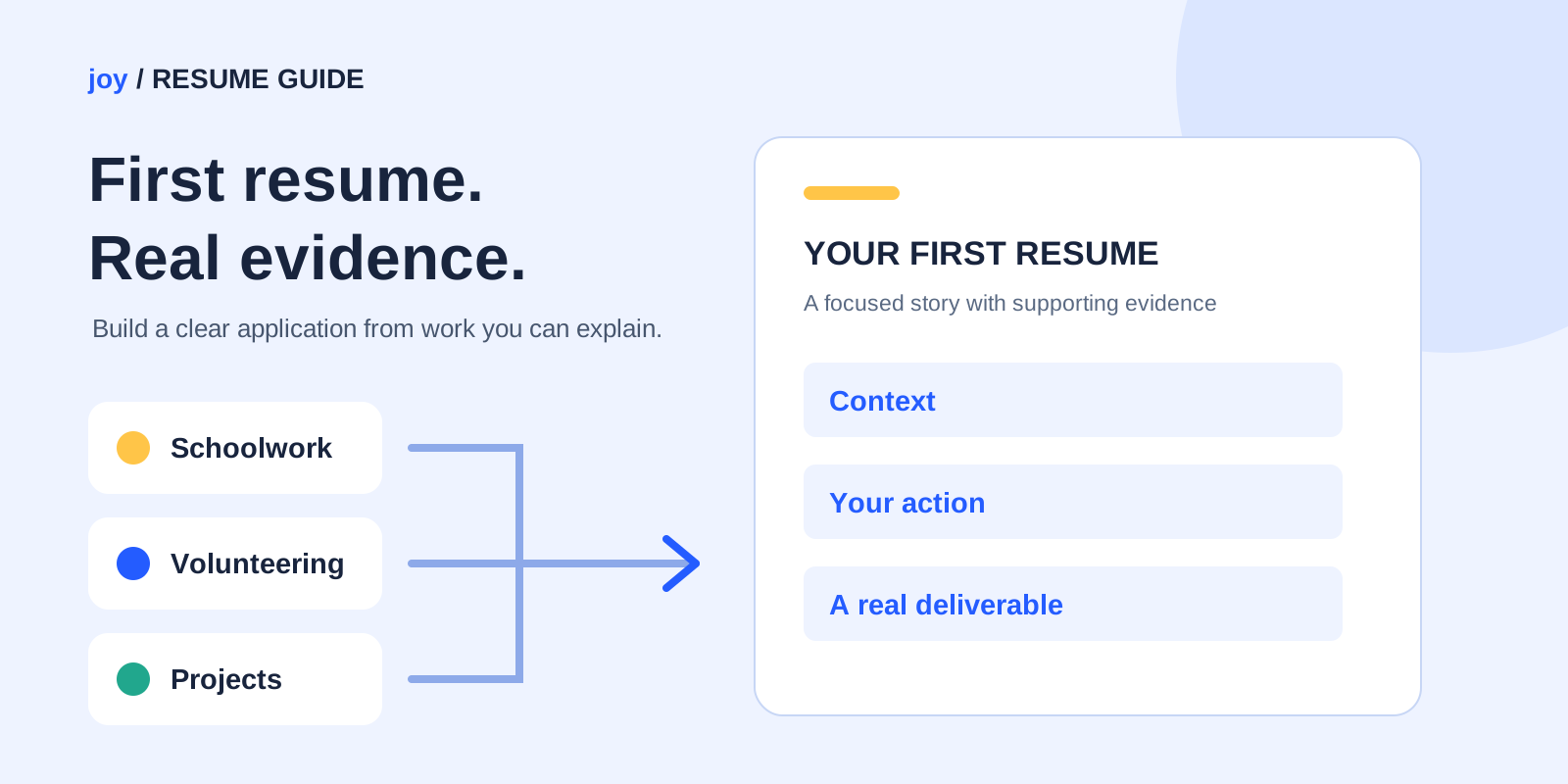
A first resume needs evidence, even when there is no employment history to list. Coursework, volunteering, independent projects, and responsibilities outside school can supply that evidence. The task is to show what happened, what you personally did, and how that work relates to the role.
This guide builds a first-job resume from an evidence inventory, then walks through a complete example. The advice is aimed at general US job applications; use an employer's instructions when its requirements differ. Every person, organization, and achievement in the worked example is fictional, not a customer success story or a claim to copy unchanged.
If you already have a work history but are entering a different occupation, start with our career change resume guide instead. That application needs to translate existing experience, rather than build a first employment story.
What to put on a resume with no experience
Start with a contact section, education, relevant projects or activities, and specific skills. Add a short summary only when it helps explain the target role. A section called Work Experience is unnecessary when nothing belongs in it. Relevant Experience, Projects, or Volunteer Experience can describe the evidence more accurately.
The CUNY resume guide organizes experience around an organization, title, dates, and descriptions of work. Apply that structure to a school project or volunteer role without presenting it as paid employment.
| Possible evidence | What makes it useful | What to avoid |
|---|---|---|
| A class project | Your contribution, a method, and a finished deliverable | Listing the course name as proof of every skill |
| Volunteering | Real duties, dates, and the people or process supported | Converting occasional help into a management title |
| A personal project | An artifact that someone can inspect or discuss | Calling a practice project client work |
| A club or team | A responsibility you actually held | Taking credit for the whole group's outcome |
| Informal family work | A truthful description of tasks and context | Inventing an employer, salary, or employment contract |
An unfinished course can still supply a completed project. Label the project and your enrollment status accurately; it does not turn an unfinished qualification into a degree.
Choose one job before choosing your sections
An entry-level office assistant and a junior developer need different evidence. Save one job description and underline three responsibilities you could support with examples. Ignore broad adjectives such as passionate until the practical requirements are clear.
For an office assistant opening, those responsibilities might be maintaining records, answering routine questions, and preparing documents. A student could connect them to a spreadsheet assignment, a community event, and meeting notes. A developer opening would call for different proof: readable code, tests, and an explanation of a technical decision.
Create a small matching sheet before writing:
| Job requirement | Evidence available | Best place on the resume |
|---|---|---|
| Maintain accurate records | A spreadsheet with validation checks | Projects |
| Answer visitor questions | A recurring volunteer reception duty | Volunteer Experience |
| Prepare written materials | An event checklist and instruction sheet | Relevant Experience |
Leave a requirement blank when there is no evidence. That is a useful learning target, not permission to add the skill anyway. If the role requires a mandatory credential you do not hold, wording cannot substitute for that credential.
Build an evidence inventory before writing bullets
Open the files, notes, or finished work connected to each activity. Memory tends to preserve the exciting team result and lose the smaller task you actually owned. The artifact helps separate them.
For each candidate example, record:
- Context: Was this a course, volunteer assignment, personal project, or paid role?
- Your action: What did you make, change, check, explain, or organize?
- Tools: Which software or equipment did you personally use?
- Deliverable: What existed at the end that did not exist before?
- Evidence: Can you describe it, show a permitted sample, or explain the method?
A spreadsheet assignment might yield: checked inconsistent date formats, added a validation rule, and wrote a short handover note. Those are concrete actions. Advanced data analysis is a broader claim and might be unsupported.
Private work does not need to become a public portfolio. Describe the method without uploading classmates' records, customer information, or restricted files. If you recreate a sample with made-up data, label the sample as a demonstration rather than an original business dataset.
Put the strongest evidence near the top
For a student whose recent coursework is relevant, a useful order is contact details, summary, education, projects, volunteer experience, and skills. For someone whose volunteering is stronger than their schooling, move Relevant Experience above Education.
Keep entries in reverse chronological order within each dated section. Headings can change the emphasis without changing the timeline. Avoid making the reader search through a large list of unsupported skills before finding an example.
A one-page draft is a practical starting point for a first job, not a rule that justifies tiny text. Remove repeated claims and unrelated detail before reducing the font. Keep enough spacing to distinguish an organization, a role, and its bullets.
In the contact section, use a professional email, a reliable phone number, and your city or region if useful. Add a portfolio only when it supports this application. Do not place identity-document numbers in a general first-job resume; an employer's separate onboarding process is a different task.
Write a summary that points to evidence
Hardworking individual seeking an opportunity could describe almost anyone. A better summary names the target work and connects it to evidence below. It should not suggest that a first-time applicant already has years in that occupation.
Fictional office-assistant example:
Business administration student seeking an office assistant role. Built spreadsheet checks for a class records project and supported visitor check-in at a community event. Comfortable preparing clear documents and explaining routine instructions.
This summary makes limited claims. The reader should find the spreadsheet project and event duty in the following sections. If either statement cannot be supported, remove it.
An objective can help when the intended role is otherwise unclear, but avoid spending the opening on what the employer will teach you. Use the space to show what you can contribute now and what work you are seeking. There is no requirement to include both a summary and an objective.
Describe projects as work you can explain
Use the project name, its context, dates, and two or three relevant bullets. A group project should make your individual contribution visible. Name a tool only if you used it yourself.
Compare these fictional descriptions:
Too vague: Worked on a project and developed teamwork skills.
More useful: Created the spreadsheet's date-validation checks and documented how teammates should resolve missing entries before the final presentation.
The second version gives the interviewer something specific to ask about. It does not claim that the class exercise increased a company's revenue or saved staff time. A completed checklist, a working prototype, or a clearer handover can be a valid deliverable without a percentage.
Use numbers when you can substantiate them. If the worksheet contained 40 sample rows, that describes the assignment's scope; it is not evidence of a 40% improvement. For more examples of this distinction, see our guide to resume bullets without invented metrics.
A complete first-job resume example
The following fictional candidate is applying for an office assistant position. The sample shows how separate activities can support the same target role. Replace every detail with your own facts; do not submit the demonstration email or fictional organizations.
MAYA CHEN
Office Assistant Candidate
City, State | maya@example.com | Your phone number

SUMMARY
Business administration student with experience preparing documents,
checking spreadsheet records, and supporting community event check-in.
Seeking an office assistant role involving accurate records and clear
communication.

EDUCATION
Westbridge Community College (fictional)
Associate degree in Business Administration, expected May 2027
Relevant coursework: Business Communication; Spreadsheet Applications

PROJECTS
Records Review Exercise | Spreadsheet Applications course
September–October 2026
- Built date-validation checks for a fictional registration worksheet.
- Flagged missing fields and documented the correction steps for teammates.
- Prepared a short instruction sheet for the final class handover.

VOLUNTEER EXPERIENCE
Event Check-in Volunteer | Northbank Community Program (fictional)
June–August 2026
- Checked visitors against the organizer's registration list.
- Explained room locations and referred schedule changes to the coordinator.
- Prepared table signs and returned completed check-in records after events.

SKILLS
Spreadsheets: sorting, filtering, basic formulas, data validation
Documents: formatting instructions, proofreading, meeting notes
Languages: English
The sample does not include a made-up employer to fill space. Its summary is supported by the entries. Its volunteer title describes the responsibility without implying authority over the event. Its education line makes the expected completion date clear.
Notice what has been left out: a photo, a page of personality adjectives, an invented customer-satisfaction result, and a list of every school subject. The space is used to support one job target.
Adapt the same evidence for a different opening
Changing the job title at the top is only the first edit. For a customer service opening, the check-in work could come before the spreadsheet project. A bullet could emphasize listening to a visitor's question and directing them to the right person, if that happened.
For a data-entry opening, the spreadsheet checks would deserve more space. Describe how you found missing values or verified formats. Do not add database administration because the listing mentions databases; sorting a spreadsheet is not the same activity.
Use the employer's terminology where it accurately describes your work. An instruction sheet might demonstrate written communication. It should not become technical documentation for enterprise software unless that was its actual purpose.
Keep a master evidence document and make a separate application copy. This avoids losing an example that may suit another role. It also makes it easier to check that each tailored sentence is still true.
If you have no projects or volunteering either
A blank inventory is a signal to build a small piece of relevant evidence. Choose a task similar to one responsibility in the target role, complete it, and save the result. Do not wait for an elaborate portfolio website.
For an office role, create a fictional appointment sheet and write instructions for checking it. For a junior coding role, build a small program, explain its limits, and add tests you understand. For a writing role, draft a short how-to article with sources and revise it after feedback.
List the work as an Independent Project with its real dates. A practice exercise does not become an internship, and a course badge does not prove professional experience. The value is that the finished artifact makes a skill discussable.
Use only tools you can afford and access legitimately. A completed, modest project you understand is more defensible than a large AI-generated sample you cannot explain. Keep an honest note of what you did yourself and where you used assistance.
Check the file and the application form
A readable document and correct application fields are separate checks. Greenhouse's parsing guidance identifies image-only files, complicated layouts, columns, and some header or text-box arrangements as possible parsing problems. That is a provider-specific warning, not a universal ATS rejection rule.
For a straightforward first-job application, start with clear section headings and a simple reading order. Follow the requested file type. If PDF is accepted, confirm that its text is selectable; a screenshot saved as a PDF is still an image.
After uploading, inspect the fields the application populated. Correct missing education, mixed-up dates, or a project placed under employment. A successful upload message does not prove every field was understood.
Choose a resume template that lets you keep the important material readable. In JoyResume, review any AI proposal before applying it and remove claims that your evidence does not support. No layout or score guarantees an interview.
A final evidence check before sending
Read the resume while keeping the job description beside it. Can you point from each important requirement to a real example? A short document with that connection is ready for a more useful review than a longer list of aspirations.
Check these details one at a time:
- Each role, project, and qualification is labeled accurately.
- Expected graduation is not presented as a completed degree.
- Every number has a source you can explain.
- A team result is separated from your contribution.
- Tools and languages reflect your actual ability.
- Contact details work, links open, and private records are excluded.
- The uploaded application matches the document's facts.
Then practice explaining one project aloud. Our STAR interview guide can help organize the explanation. If you cannot describe a sentence naturally, revise the sentence before sending another application.
Frequently asked questions
Can I make a resume if I have never had a job?
Yes. Use education, completed projects, volunteering, or other relevant responsibilities as evidence. Name each context honestly and remove an empty Work Experience section. A first resume does not need a fictional employment history.
Should I put unrelated part-time work on it?
Include it when it demonstrates something useful for this opening, such as handling transactions, following a procedure, or communicating with customers. Give the relevant duties space and shorten unrelated detail. Do not relabel the job as your target occupation.
Do I need a summary or an objective?
Neither is mandatory. Add a brief opening when it helps connect your background to a specific role. If it only repeats the skills and education directly below, use that space for stronger evidence instead.
What if the listing asks for experience I do not have?
Distinguish preferred experience from essential qualifications, and assess the actual responsibilities. Apply with an honest account of your evidence if the role is a reasonable match. Do not change dates, invent paid work, or claim a required license you lack.
Can AI write the first draft?
AI can help organize supplied facts and suggest clearer wording. Check every claim, title, number, and tool against your own records before applying changes. A polished sentence is only useful when you can explain and support it.