
Career Change Resume: Examples and a Writing Guide
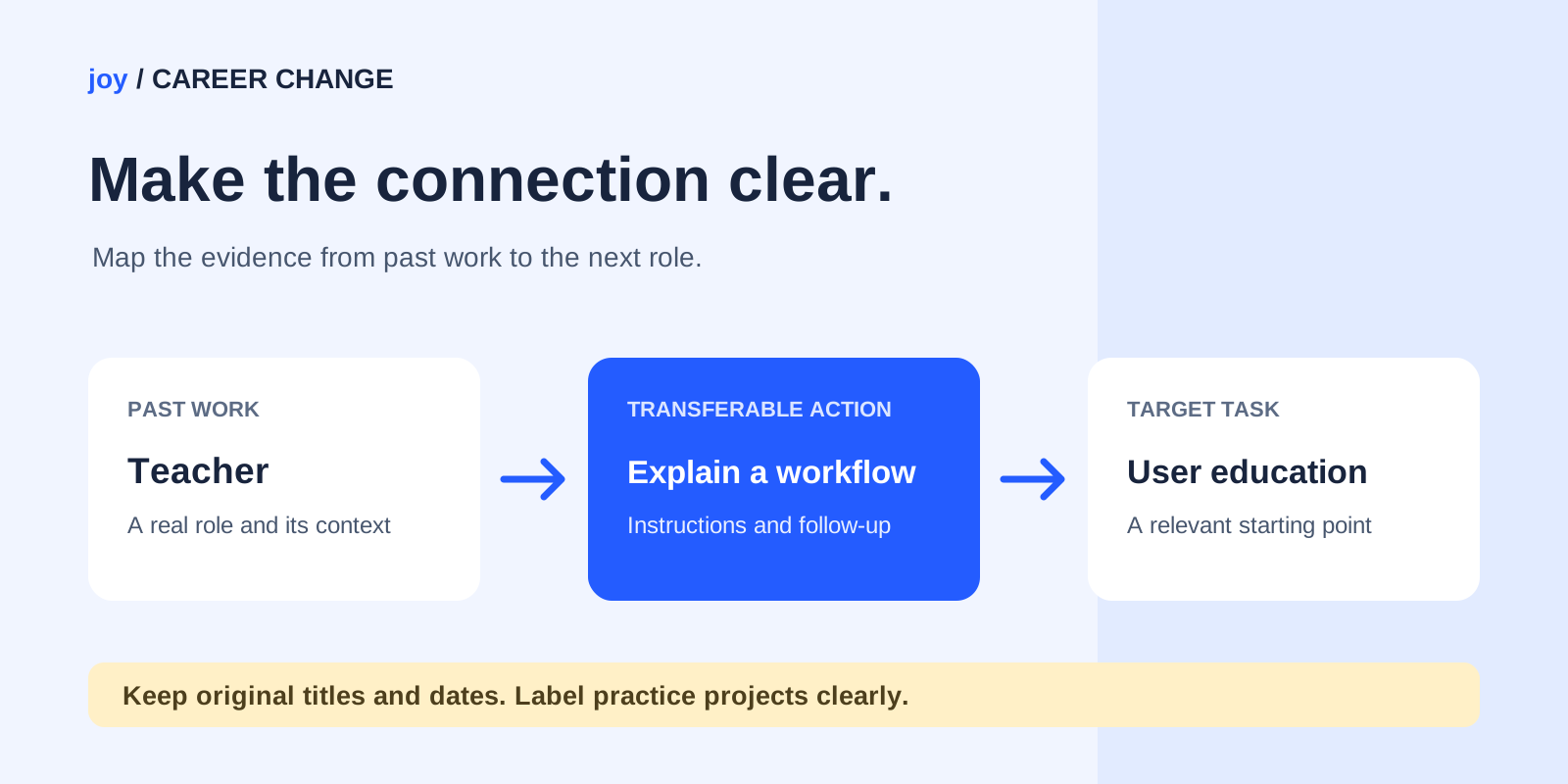
A career change resume has to make a new direction understandable without rewriting the past. Keep your real job titles and dates, then show which parts of that work are useful in the role you want next. The strongest connection is an example, not a new label attached to an old responsibility.
This guide uses a teacher moving toward customer success to show the process. The candidate, employers, dates, and project are fictional teaching examples. They illustrate a method for general US applications; they are not evidence that a particular transition or resume guarantees a hiring outcome.
Start with one target role and its actual work
Career change is too broad to be a useful resume headline. Choose an occupation and a plausible level. Customer support, customer success, account management, and sales may appear together in job searches, but an opening can assign very different responsibilities to each.
Read several relevant postings, then choose one to draft against. Separate the work into three groups: tasks you have performed, tasks with a related underlying skill, and tasks you have not done. Pay particular attention to required credentials, technical capabilities, and the scope of ownership.
A teacher might have strong evidence of explaining complex information and following up on problems. That does not establish experience negotiating commercial renewals or managing a SaaS account portfolio. Keep those distinctions visible from the start.
The MIT career-switcher resume handout discusses using a summary to connect relevant skills when previous titles do not make the connection obvious. Use the summary as a bridge to evidence, not as a replacement for it.
Build a transferable-skills evidence map
Transferable skills become useful when the reader can see where you used them. For each important requirement, write down an example, the original context, and the limits of the comparison. Keep this working table outside the resume.
| Target responsibility | Existing evidence | Accurate connection | Limit to preserve |
|---|---|---|---|
| Explain a product to new users | Taught families to use a learning portal | Wrote instructions and answered questions | Not commercial customer onboarding |
| Track unresolved issues | Kept a follow-up log for family enquiries | Documented questions, owners, and next steps | Not ownership of a SaaS support queue |
| Work with internal teams | Coordinated with teaching and office staff | Shared context and agreed handoffs | Not an enterprise implementation program |
| Manage renewals | No direct example | A current learning need | Do not claim retention or renewal results |
This table protects against an easy mistake: matching a familiar word while changing the meaning of the work. A school engagement measure does not become net revenue retention. Resolving a parent's question does not prove that you handled a software incident with a paid service-level agreement.
The table also shows where the transition is credible. Clear instructions, disciplined follow-up, and thoughtful handoffs can be relevant across settings when their original context is stated.
Use a combination layout without hiding chronology
For many career changes, a short summary and a focused skills section can introduce the new direction, followed by dated work history. This combination lets the reader see the connection and still understand the timeline.
The New York Department of Labor's resume guidance describes combination resumes as one option for presenting skills with experience. A useful format depends on the application; a layout does not make an unsupported qualification stronger.
A practical section order is:
- Name and contact details.
- A target-focused professional summary.
- Relevant skills supported by examples below.
- Selected transition project, if it is strong and recent.
- Professional experience with original titles and dates.
- Education and relevant, accurately labeled training.
Avoid repeating the same achievement under Skills, Highlights, Projects, and Experience. A long skills-only opening can bury the dates and context the reader needs. Give each fact a main home, then make the summary concise enough to point toward it.
Write a summary that explains the bridge
The opening should answer what you are targeting, what useful background you bring, and what evidence makes the transition more than an intention.
Weak: Results-driven customer success manager with a proven record of customer retention.
That statement invents an occupational track record for a teacher who has not held that role.
More accurate fictional example:
Educator transitioning to customer success, with experience explaining digital workflows, documenting recurring questions, and coordinating follow-up across teams. Created a practice onboarding guide and sample enquiry log for a fictional software product. Seeking a role focused on user education and clear customer communication.
The phrase transitioning to matters. It identifies the direction without changing the previous job. The practice project adds current evidence, while the word practice prevents it from looking like a customer engagement.
If your transition already includes paid work in the new field, lead with that experience instead. A person who has completed a real support contract has a different story from someone preparing for a first support role. Do not force every career changer into the same summary.
Translate responsibilities while keeping their meaning
Replace internal jargon with language that an outside reader can follow. Keep the real setting, authority, and scope intact.
For example, coordinated parent evenings may be unclear outside education. Prepared the event schedule, sent instructions to families, and documented unanswered questions describes the work. Replacing the sentence with directed enterprise customer success operations changes its meaning and seniority.
Use a simple editing sequence:
- Identify the useful action inside the original task.
- Explain who or what the action supported.
- State the deliverable or observable outcome.
- Retain the context that limits the claim.
Fictional before: Responsible for parent engagement and learning technology.
Fictional after: Wrote a portal setup guide for families and recorded recurring access questions so teaching and office staff could give consistent instructions.
The revised bullet contains a recognizable communication and documentation task. It does not imply product ownership or a revenue result. If no reliable metric exists, use the deliverable; our guide to evidence-based resume bullets covers that approach in more detail.
Close a real gap with a small, labeled project
Changing vocabulary cannot supply a missing tool or work sample. Pick a modest project tied to a responsibility you want to demonstrate. Finish it before giving it prominent resume space.
For the teacher-to-customer-success example, a useful practice project could include a short onboarding guide, a sample enquiry log, and an escalation note. Use a fictional product and synthetic records. Show the assumptions: who the user is, what they are trying to do, and when an issue should be passed to another team.
The project can demonstrate written communication and organization. It does not demonstrate a real customer's adoption, product usage, satisfaction, or retention. Avoid adding imaginary clients or business results to make the exercise sound larger.
If you learn a CRM through a demonstration environment, describe what you actually completed. A guided tutorial is different from administering the system for an employer. A course in progress belongs under Professional Development with its current status, not under completed certifications.
Keep a shareable artifact and a private note of the process. You should be able to explain one decision, one limitation, and what you would change for a real customer.
A complete career change resume example
This fictional example targets an early customer-success opportunity centered on user education. It would need further tailoring for a role focused on commercial account ownership. Do not copy the candidate's history, qualifications, or demonstration contact details.
NADIA PATEL
Educator transitioning to Customer Success
City, State | nadia@example.com | Your phone number

SUMMARY
Educator with experience explaining digital workflows, preparing user
instructions, and coordinating follow-up across teams. Completed a
practice customer-onboarding project using a fictional software product.
Seeking a customer success role focused on user education and clear
communication.

RELEVANT SKILLS
User instructions | Question tracking | Written communication
Cross-team handoffs | Presentation preparation

SELECTED PROJECT
Practice Customer Onboarding Kit | Independent project
September–October 2026
- Created a getting-started guide for a fictional scheduling application.
- Built a sample enquiry log with issue, owner, next action, and status fields.
- Wrote an escalation note showing when to refer a question to a specialist.

PROFESSIONAL EXPERIENCE
Teacher | Riverside Learning School (fictional)
August 2020–July 2026
- Wrote a learning-portal setup guide and answered routine access questions.
- Recorded unresolved family enquiries and coordinated follow-up with staff.
- Prepared event instructions and shared updates when arrangements changed.

EDUCATION
Bachelor of Education | Eastfield University (fictional)
Completed June 2020

PROFESSIONAL DEVELOPMENT
Self-directed study: customer onboarding workflows
August–September 2026
Applied the study to the fictional onboarding kit described above.
The example keeps Teacher as the job title and places the new field in the headline. It names the project as practice, includes dates, and separates learning from paid work. That combination gives the reader a clear account of both preparation and limits.
Adapt the bridge for other career changes
A retail supervisor moving toward operations coordination might emphasize shift planning, inventory checks, and incident handovers. Keep the store context. Do not describe a local rota as global workforce planning.
A marketer moving toward data analysis could use a real reporting task, then add a project demonstrating data cleaning or analysis. Make clear whether a dataset was collected at work, public, or synthetic. Using a dashboard does not automatically establish the ability to build its data model.
A nurse moving toward a nonclinical training role could describe instruction design and explaining procedures. Keep patient information out of the application. Do not imply a new professional license or a completed training qualification when the underlying evidence is clinical practice.
Across these transitions, the method stays the same: identify an actual action, explain its relevance, and preserve the boundary between related experience and direct experience. The exact job requirements decide which examples deserve space.
Decide what to shorten from the old career
Experience does not become irrelevant simply because it happened in another field. It becomes less useful when it does not help explain the target work or establish the employment timeline.
Keep recent employers, dates, and titles visible. Give more space to the duties that support the new role. Older or less relevant positions can be summarized when the application does not require a full history. A mandatory application form may still ask for information that your targeted resume omits.
If the change follows a break from paid work, our employment-gap guide covers a concise explanation that preserves the chronology. The break and the change of direction do not need competing personal statements.
Remove jargon that only insiders understand, repeated responsibilities, and old tools that do not support the move. Do not delete enough context to make the reader think a project was a job or a qualification was completed recently.
There is no universal page count for every career changer. Make the bridge and strongest evidence easy to find, then check whether a second page adds useful material. Compress repetition before compressing the text into a difficult layout.
Tailor for the application without chasing an ATS score
Use job-description terms when they accurately name a skill or action you can support. A requirement for onboarding materials can connect to a genuine user guide. A requirement for Salesforce administration cannot be met by inserting the phrase into an otherwise unrelated bullet.
File structure matters too. Greenhouse documents some parsing failures involving columns, graphics, image-only resumes, and complex document structures. Follow the employer's file instructions and inspect populated fields after upload. Parser behavior is not the same thing as a hiring decision.
In JoyResume, use a readable resume template and review suggested changes against your evidence map. AI can help explain a connection; it should not silently replace a past title, add a credential, or turn practice work into paid experience. A matching score is a prompt for review, not proof that you meet every requirement.
Prepare to explain the transition after the resume
The resume establishes the bridge. A cover letter or interview can explain why you want to cross it. Keep that explanation specific to the work, rather than presenting the old profession as a mistake.
Fictional interview opening:
Teaching showed me that I enjoy helping people understand a tool and become confident using it. I want to focus more directly on that work in a customer success role. My recent practice project gave me a starting point for discussing onboarding and issue handoffs, and I am looking for a position where I can build direct product experience.
Practice a follow-up that tests the limits: What have you not done yet? A useful answer might acknowledge the lack of commercial renewal experience and explain the preparation relevant to the advertised role. Do not claim a missing capability just because the question feels uncomfortable.
Use our STAR interview guide to prepare one evidence-backed story from the old career. Keep the facts consistent across the resume, application form, portfolio, and conversation.
Frequently asked questions
Should I change my old job title to match the new career?
Keep the real title. You can add a clear functional explanation when a title is obscure, but do not replace Teacher with Customer Success Manager. State the target role in the headline or summary and prove the connection in the bullets.
Is a functional resume better for changing careers?
A skills-led opening can help, but it should not make the chronology difficult to understand. A combination layout with a short summary, relevant skills, and dated experience is a practical option. Follow any employer-specific format requirements.
Do I need a new degree before applying?
Check the actual role. Some occupations require particular credentials; others allow several routes to demonstrating capability. Do not assume a short course replaces a required degree or license. Use a project to investigate a skill gap before making a large training commitment.
Can I include a self-directed project?
Yes, when it is relevant, completed enough to discuss, and labeled as independent or practice work. Describe your contribution and the artifact. Keep synthetic data, demonstration clients, and imagined outcomes distinct from real commercial experience.
What should I do when I cannot prove a required skill?
Leave the claim out. Decide whether it is something you can learn, a reason to target a different level, or a requirement that makes this opening unsuitable for now. A truthful gap is more useful for planning than a convincing sentence you cannot defend.