
Employment Gaps on a Resume: How to Explain Them
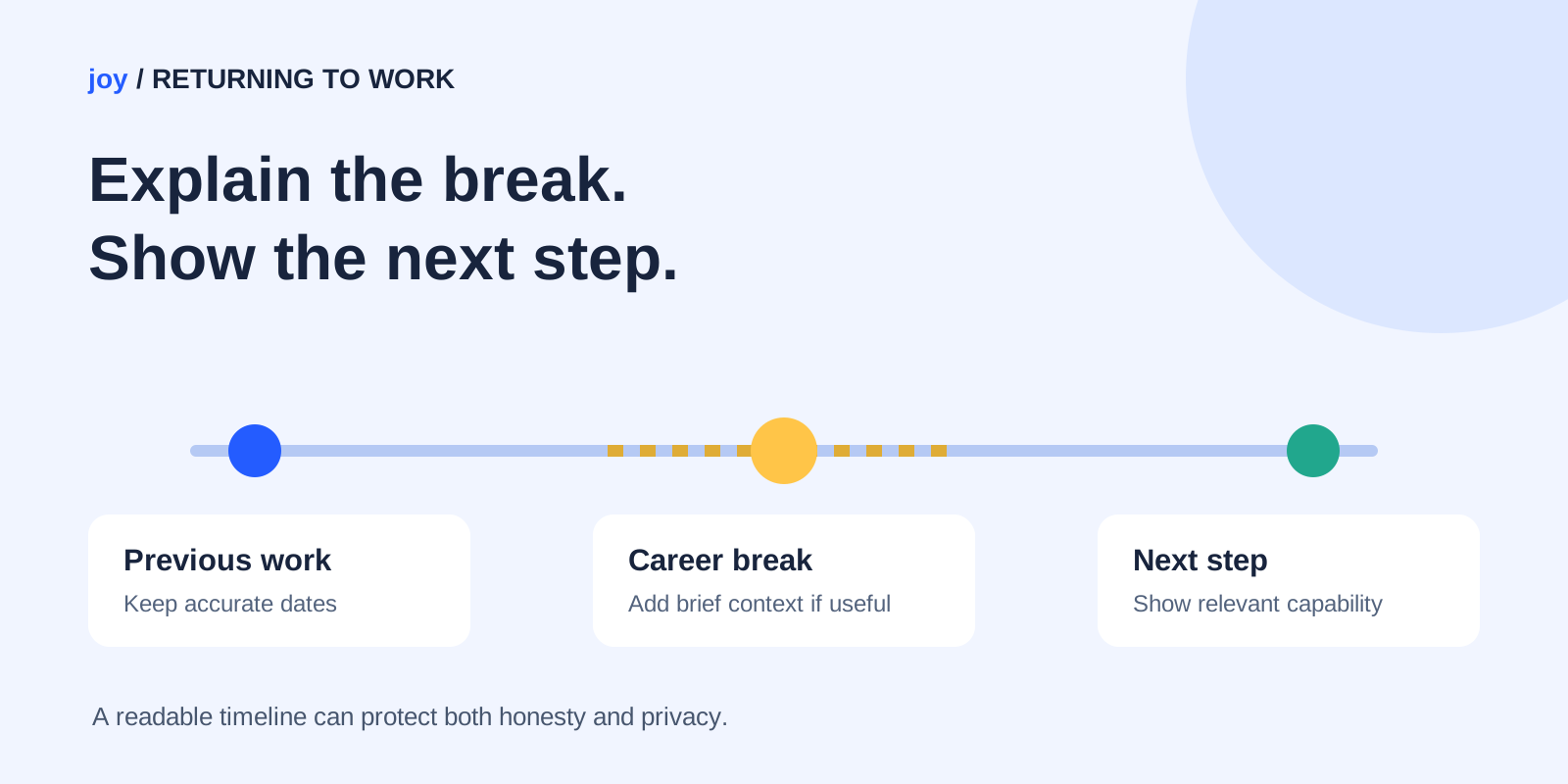
An employment gap does not need to become the main subject of a resume. Keep the work dates accurate, add a brief explanation when it helps the timeline make sense, and give the most space to evidence relevant to the job. A calm description is more useful than a complicated attempt to make the time disappear.
This guide separates the resume, application form, cover letter, and interview so each can do its own job. The examples are fictional wording demonstrations for general job applications, not hiring promises or statements about your circumstances. Use only the details that are true for you and follow the employer's instructions.
Decide whether the gap needs its own entry
There is no single number of months that makes every gap unacceptable or every explanation necessary. Look at how the break affects the story in this particular resume. A recent, substantial break may benefit from a short entry. A brief transition between dated jobs may need no additional line unless the application asks for it.
CareerOneStop's guidance on special resume circumstances emphasizes truthful employment dates and explains that a break can also be discussed in a cover letter or interview. Use that flexibility to make the application clearer, not to create a misleading timeline.
| Situation | A useful starting approach | Detail to check |
|---|---|---|
| A short period between recent jobs | Keep accurate dates; prepare an explanation | Does the application ask about every period? |
| A substantial recent career break | Consider a brief, dated Career Break entry | Does it explain the timeline without overwhelming it? |
| An old break outside the selected work history | Focus on the relevant experience retained | Is a complete history required elsewhere? |
| Study or a completed project during a break | Put the actual activity in its proper section | Was it study, practice, volunteering, or paid work? |
| Irregular contract work | List real engagements or a clearly explained umbrella entry | Do the dates imply continuous paid work? |
The resume is a selected account of relevant experience. A form asking for a complete employment history is a separate request and may need more detail.
Reconstruct the timeline before writing an explanation
Make a private record of start dates, end dates, contracts, study periods, and any break you plan to mention. Compare it with the records you can access, such as an offer letter, a contract, or a course completion record. Do not rely on a polished old resume if its dates are uncertain.
Use a consistent date style in the application document. Month and year can make a recent sequence easier to follow. Do not extend a role's end date to absorb time you did not work there, and do not label a past job Present after it has ended.
Some people choose to summarize older experience, and some resumes use years. The important test is whether the presentation misleads the reader about when or how long you worked. If an application requests exact dates, supply the requested precision rather than copying a shortened resume date.
Keep uncertain details in your working notes until you can check them. Approximate dates, if the application permits them, should not later be described as verified exact dates. A consistent factual record prevents different explanations from developing across documents.
Keep the break description short and proportionate
A useful entry can be a heading, dates, and one sentence. It does not need a persuasive job title. Career Break, Family Caregiving, or Professional Development may fit when they accurately describe the period.
Fictional caregiving entry:
Career Break — Family Caregiving | June 2024–October 2026
Took time away from paid work for family caregiving responsibilities.
That entry explains the chronology. It does not turn caregiving into employment or reveal another person's private circumstances. You can add a relevant activity only if it happened and helps this application.
The National Careers Service's gap guidance recommends openness while noting that people do not need to share every personal or health detail. Treat privacy and accuracy as compatible goals: a broad, truthful explanation can be enough.
Avoid a long paragraph defending the break before the reader sees your experience. Also avoid a manufactured executive title for unpaid personal responsibilities. The goal is a readable timeline and useful evidence, not an attempt to make every month look like a promotion.
Wording examples for common situations
Different reasons call for different wording. The following lines are fictional options, not categories that you must disclose or labels that an employer will necessarily prefer. Adapt the language to what you are comfortable sharing and what the application requests.
Caregiving or parenting
Career Break — Family Responsibilities | March 2023–August 2026
Took a planned break from paid employment for family responsibilities.
Only use planned if it was planned. If you want a more private heading, Career Break may be sufficient. Add a course or volunteer activity separately rather than implying that personal care was a commercial role.
A layoff followed by a job search
Career Break | February–July 2026
Position ended during a departmental restructure; pursued relevant opportunities and completed an independent reporting project.
Keep the project only if it exists. You can omit the second clause if the period was simply a job search. Do not invent training because you feel a search alone is an inadequate explanation.
Time away for health or personal reasons
Career Break | September 2024–May 2026
Took time away from work for personal reasons.
This is a broad explanation. Do not add a diagnosis, a claim of recovery, or a statement about availability unless you want to share it and it is accurate. Requirements for a particular application or adjustment request should be handled through the appropriate process, rather than guessed from a generic resume example.
Study or professional development
Professional Development | January–June 2026
Completed a part-time bookkeeping course and a practice reconciliation project using synthetic transactions.
State the real provider and qualification elsewhere if relevant. Enrolled, in progress, completed coursework, and certified mean different things. Use the one that matches the evidence.
Travel or relocation
Career Break — Relocation | April–August 2026
Relocated to a new region and prepared to resume office administration work.
Do not add a new language, international business experience, or immigration status simply because travel or relocation occurred. Those are separate facts, and many do not belong in a general resume.
Show current capability without inventing a productive break
A person does not have to complete a professional project during a difficult period to justify returning to work. If you did study, volunteer, or build something relevant, describe it. If you did not, use your earlier work evidence and consider one small present-day refresh task.
For an administration role, a refresh task might be a fictional scheduling worksheet with error checks and a short instruction note. For a writing role, it might be an edited article. For a technical role, it might be a small project with tests and a clear explanation of its limits.
Label each activity honestly. A practice exercise is not consulting. A course exercise is not employment. A personal project cannot establish a real customer's revenue or satisfaction result.
Keep the activity's actual dates. Completing a course in September does not mean you spent the whole preceding two-year break in professional development. Our guide to resume bullets without invented metrics can help describe a real deliverable without adding unsupported results.
A resume example after a career break
This fictional applicant is returning to an office coordination role after caregiving. The example keeps earlier professional evidence visible and gives the break a limited, factual entry. Its contact details and organizations are demonstrations only.
SAM RIVERA
Office Coordinator
City, State | sam@example.com | Your phone number

SUMMARY
Office administration professional with experience preparing schedules,
maintaining records, and coordinating supplier enquiries. Returning to
paid work after a family-caregiving break. Recently completed a practice
scheduling worksheet to refresh spreadsheet and documentation skills.

RELEVANT SKILLS
Scheduling | Record checking | Supplier communication
Document preparation | Spreadsheet sorting and validation

RECENT PROJECT
Scheduling Worksheet Refresh | Independent practice project
September–October 2026
- Built a fictional appointment worksheet with date and required-field checks.
- Wrote instructions for recording a cancellation and rescheduling a booking.

CAREER BREAK
Family Caregiving | June 2024–October 2026
- Took time away from paid employment for family caregiving responsibilities.

PROFESSIONAL EXPERIENCE
Office Administrator | Brookside Services (fictional)
April 2021–May 2024
- Maintained the shared appointment calendar and recorded schedule changes.
- Checked supplier invoices against the office order log before review.
- Prepared handover notes covering outstanding enquiries and next actions.

EDUCATION AND TRAINING
Certificate in Office Administration
Eastfield Training Center (fictional), completed March 2021
The summary makes the return visible without apologizing for it. The break has dates, while the refresh project has its own narrower dates. The previous job still supplies the main professional evidence.
If you are still on a break, do not assign it an invented end date. You can use an accurate ongoing date and explain your intended availability where the application requests it. Returning to work is a job-search direction, not proof that every personal circumstance has ended.
Give each application document a different job
The resume should be quick to scan. A cover letter can connect the return to the particular opening, and an interview gives room for a short explanation followed by evidence.
| Document | What to include | What to keep out |
|---|---|---|
| Resume | Accurate timeline, a short break label if helpful, relevant capability | A lengthy personal account |
| Application form | The history and precision the questions request | A different set of dates invented to match the resume |
| Cover letter | Why this role now and which experience fits | Repeating the whole employment history |
| Interview | A brief explanation, current availability when relevant, then a work example | Unsupported claims that the situation is fully resolved |
Fictional cover-letter wording:
After a family-caregiving break, I am applying for office coordination roles that use my scheduling and records experience. Your opening's focus on supplier communication and accurate documentation closely matches my previous administration work. I would welcome the opportunity to discuss those examples and the practical spreadsheet project I completed recently.
Use that structure only if it reflects your situation. If the role is different, explain the relevant connection rather than copying a generic return-to-work paragraph.
Prepare an interview answer that moves back to the work
Practice a short explanation in your own words. You do not need to make it sound like a legal statement or a marketing script. A useful structure is reason, present direction, and relevant evidence.
Fictional example:
I took time away from paid work for family caregiving. I am now looking for an office coordination role, particularly one involving scheduling and records. Before the break I maintained an appointment calendar and checked supplier records, and I have recently refreshed those tasks with a practice worksheet.
Do not add full-time availability or say arrangements are settled unless those statements are true. If asked about availability, answer the actual question with accurate information about the role's requirements.
Prepare for the next question as carefully as the gap explanation. Describe one scheduling problem, a record-checking process, or a handover from your earlier work. The STAR interview method can help organize that example without turning the entire interview into a discussion of the break.
Avoid fixes that make the application harder to trust
Extending employment dates, listing a nonexistent business, or hiding the break behind a fabricated consulting role creates a different problem. The explanation becomes difficult to keep consistent and may imply work you cannot describe.
Be careful with summaries of genuine contract work too. An umbrella heading can be useful, but its dates and bullets should not imply uninterrupted paid engagements. Distinguish time running a business from the dates of individual client projects when that distinction matters to the application.
A skills-based opening can emphasize strengths, but it should not remove all context. New York's Department of Labor includes combination formats among the options for applicants returning after a gap. Keep the chronology readable whichever layout you choose.
Choose a resume template that has room for both the explanation and the work evidence. If you use JoyResume's AI suggestions, check that the system has not expanded a course into a qualification, changed an end date, or added an achievement during the break.
Review the timeline and the uploaded form
Before submitting, compare the resume with the private timeline you prepared. Then check the application fields after upload. Formatting and content accuracy need separate checks; a visually correct document can still populate a form incorrectly.
Greenhouse's parsing documentation notes that complex layouts and image-based resumes can cause parsing problems. Follow the requested file format and correct any wrongly assigned job title, education entry, or date. Do not assume a Career Break heading will be categorized perfectly by every system.
Finally, read the opening aloud. The intended impression is a person with relevant experience and a clear next step. If the gap explanation occupies more attention than the evidence for the job, shorten it and bring the relevant work forward.
Returning in a different occupation adds a second writing task: explaining which past skills transfer. Use the evidence map in our career change resume guide to work on that connection separately from the break explanation.
Frequently asked questions
How long does a gap have to be before I explain it?
There is no universal cutoff for every employer, occupation, or application. Consider whether a short explanation would make the recent timeline clearer, and answer any explicit application questions. Avoid treating a generic six-month or one-year threshold as a rule.
Do I have to explain a health-related break in detail?
You can keep the explanation broad and truthful, such as time away for personal or health reasons. Share only the detail appropriate to the question and your circumstances. A general resume guide cannot determine a particular application's disclosure or adjustment requirements.
Can I use years instead of months to hide the gap?
Use a consistent format that does not misrepresent the timeline. Never extend a job to cover time you were not employed. If an application asks for months or exact dates, provide the requested detail even if your resume summarizes older experience.
Should I list caregiving as a job?
Describe it as caregiving or a career break unless it was genuinely paid employment. You may discuss relevant responsibilities accurately, but do not invent a company, seniority, or commercial result to make personal responsibilities look like a conventional job.
What if I did not take courses or volunteer during the gap?
Do not invent those activities. Use a brief explanation if useful, show your earlier work evidence, and consider a modest current skills-refresh task. A difficult period does not need to be rewritten as an imaginary professional-development program.